19/2/26: Although I posted the ‘stratigraphic narrative’ for the 2025 season last week, that contains a lot of detail, but no overall interpretation – so, I am going to follow it up with a discussion of current thinking. It is a rather longer blog post than usual, but hopefully sets up the background for the next season – now less than 3 months away.
Last season we finished with a complex of pits, postholes and gullies in the western part of the site, 3 inhumation burials outside the infant cemetery (2 adults in the east of the site and another infant slightly separate from the main group), a very productive gully in the ‘smithy’ area, a probable medieval latrine – and of course the well, down in trench 5 in the south of the field.
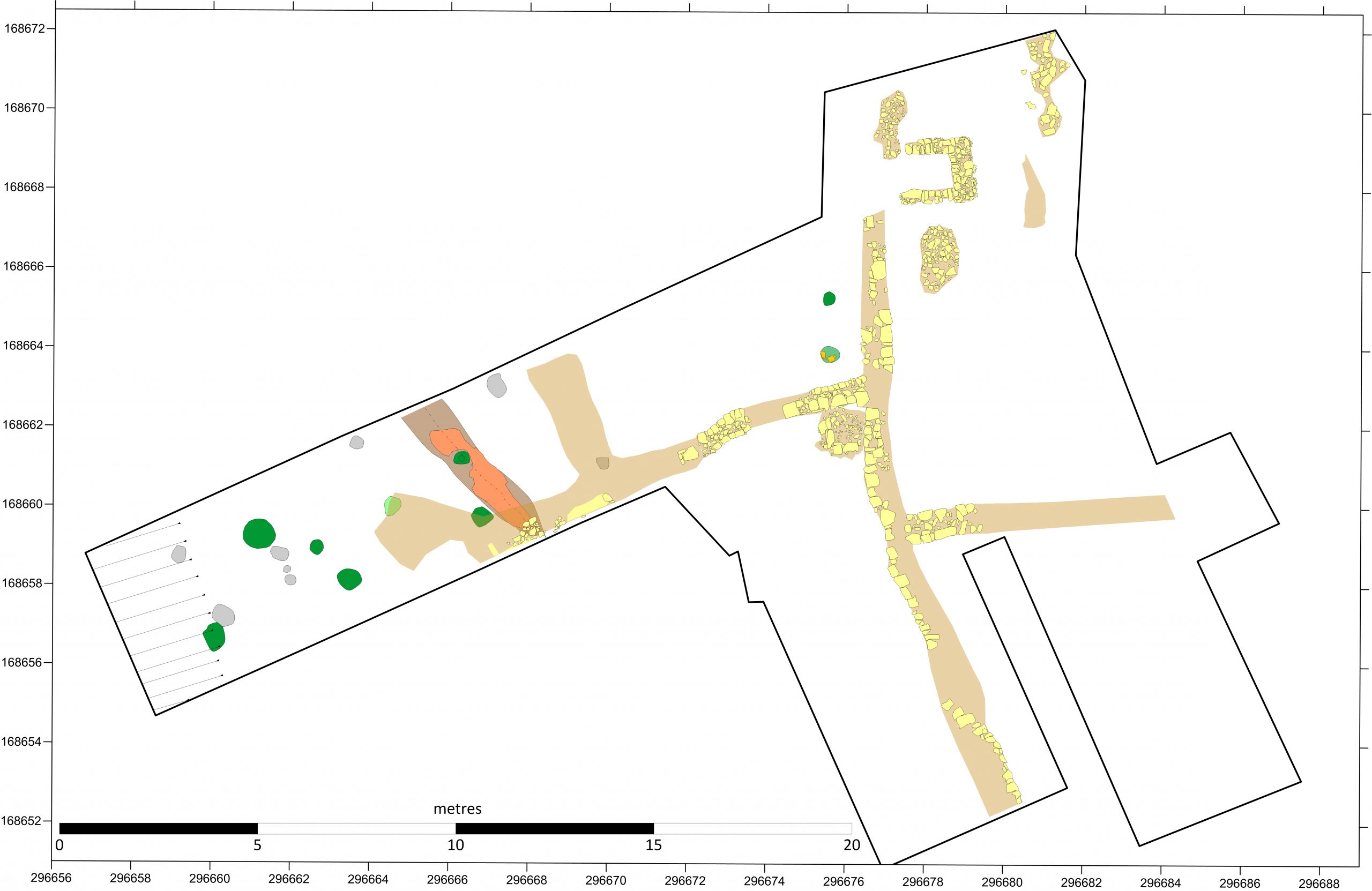
The well and some of the features in the west of the trench produced medieval pottery – mainly from the later 13th and 14th centuries. The area around the well is tentatively interpreted to have undergone two phases of quarrying – one perhaps in the 12th century and a second phase in the 14th. The medieval features in the west of the main trench are perhaps suggestive of features associated with the end of plots facing onto Burial Lane to the north. A small square building in the northeast of the site was probably a barrel latrine of 12th to 13th century age. To the west, some of the medieval pits appeared regularly spaced to the north of the stone wall. They didn’t appear to be postholes and so may perhaps be planting pits for fruit trees or something like that. There was also an enigmatic gully with a burnt fill, not quite at right angles to the stone wall, that might possibly be a boundary between different plots. Further work in this area in 2026 should help to clarify the geometry and relationships of these features.
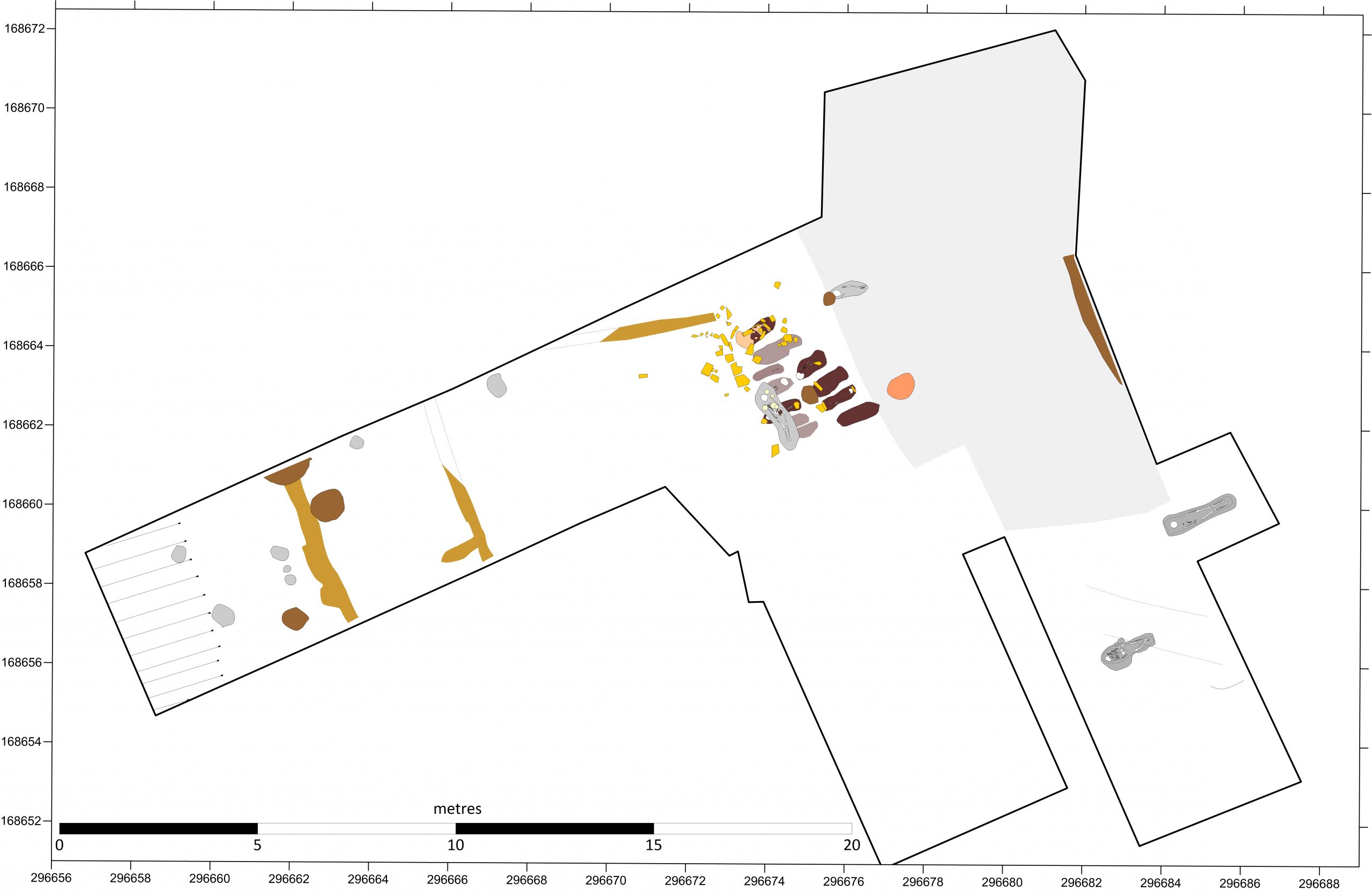
We have also acquired 12 new radiocarbon dates this winter. These were targeted at understanding the burials and the cut-features that were without pottery evidence for a medieval age – and therefore potentially early medieval. Samples from these features were processed to find suitable material for dating – and they produced small assemblages of both charcoal and burnt wheat. The two large postholes with stone packing gave rather long-ranging late 7th century to early 9th dates on the charcoal, but 15th century dates on burnt wheat. In this area, the medieval cultivation soil was very thin and it is likely that the wheat grains are intrusive from above. The earlier dates on Prunus charcoal are tentatively accepted for the features.
Rather larger assemblages of wheat grains were obtained from a series of shallow gullies or furrows. This wheat (in three samples) produced rather earlier ages of mid-6th to mid-7th century age. Burnt wheat at this period suggests an association with the corn drier(s) that we think underlie the infant cemetery – but whether that wheat was residual when it entered the gullies, or whether it genuinely dates them is a moot point. This is another thing that will be receiving close attention in the coming season. These is also a question about the gullies themselves – are they agricultural features, as we thought during their excavation, or might they be structural – and be slots for timber sill beams?
Another curious feature in the western part of the trench was, frustratingly, right on the edge of the trench. This appear to be the margin of a large pit, containing large stones (resembling the medieval soakaways perhaps…). On top of the stones was part of the spine and ribs of a cow – and this, much to my surprise, gave a good late 7th to mid-8th century date. Since the remains were articulated, this provides a much more reliable date than those from the gullies and postholes in the same area. This feature, too, is going to have to be revisited in the next season, in order to understand both what it is and its physical relationships to the gullies.
The dates from the burials also gave a fee surprises. The burial on the east edge of the site (first located at the end of the 2024 season and fully excavated in 2025) gave a remarkably early date of AD600-680 – in other words potentially broadly contemporary with the cereal driers or the early part of the metalworking. It becomes, probably, the earliest burial known from the whole site. The metalworking features now have two dates, ranging from mid-7th to later 8th century. Modelling of the dates suggests it is possible that all the metalworking was within the late 7th century, but this remains very susceptible to the model. The second burial on the east side (an extremely short young man with curiously worn teeth) gave a date with a rather long possible range from late 7th to 9th centuries, so not so easy slot into the overall site development. The third burial, a young child just slightly separate from the main infant cemetery, gave a date of late 7th into the 8th century – suggesting it may have been earlier than the main infant cemetery just to its west.
Thus, the early medieval development of the site is revealed to much more complex than we had previously understood. The early activity in the west remains associated with the cereal drier – but might now include a structural element too. The metalworking appears to start early, possibly from the middle of the 7th century – and one of the inhumations now dates to this phase as well (with the grave even having crucible fragments in tis fill). By the 8th century there is more convincing structural evidence in the west, with the smithy to its east possibly now out of use, and late in the 8th century the infant cemetery developed. It is clear that the small area we are investigating was very ‘busy’ throughout a period from the latest 6th to mid-9th centuries!
11/2/26: the post-excavation tasks from the 2025 season that were scheduled for this winter are now essentially complete. The stratigraphic narrative for the 2025 season is now available via the Resources page.
Plans for the 2026 season are now well advanced – and it will run from 18th May until 12th June. The Research Design for the 2026 season is also now available on the Resources page.